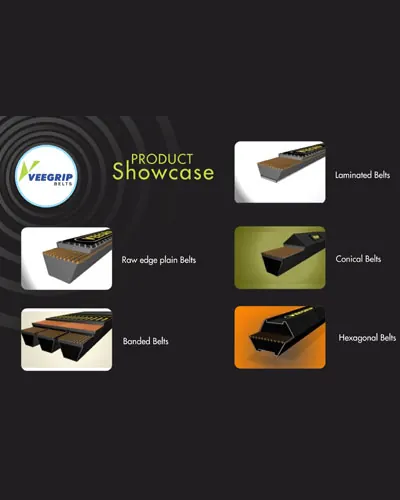

V BELT LITERATURE
Belt drives are called flexible machine elements. Flexible machine elements are used for a large number of industrial applications, viz., conveying systems, transmission of power, etc.
BELT DRIVE ADVANTAGES:
Flexible machine elements has got an inherent advantage that, it can absorb a good amount of shock and vibration. It can take care of some degree of misalignment between the driven and the driver machines and long distance power transmission, in comparison to other transmission systems, is possible.
For the entire above reasons flexible machine elements are widely used in industrial application.V-belts are the workhorse within an industry. They are available in a wide variety of standard sizes, for transmitting any amount of load power.
Principle of operation:
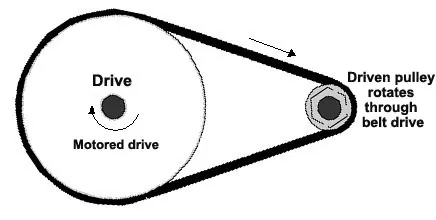
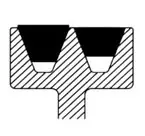
The belt drives primarily operate on the friction principle (Principle of wedging). i.e. the friction between the belt and the pulley is responsible for transmitting power from one pulley to the other. In other words the driving pulley will give a motion to the belt and the motion of the belt will be transmitted to the driven pulley.
Application of Belt drives:
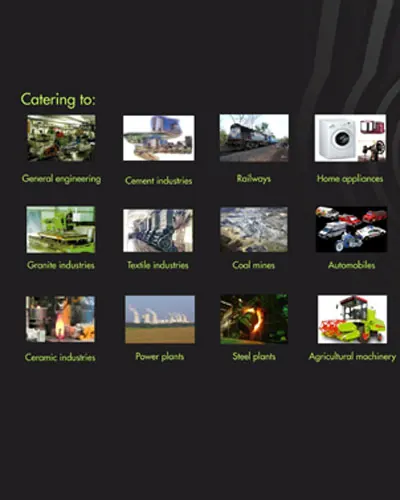
Belt drives may be used for any type of power transmission purposes such as Machinery such as agricultural equipments, Automobiles, Home appliances, Process industries like steel plants, pharmaceutical industries, sugar and paper mills, textile looms, rice mills, etc...
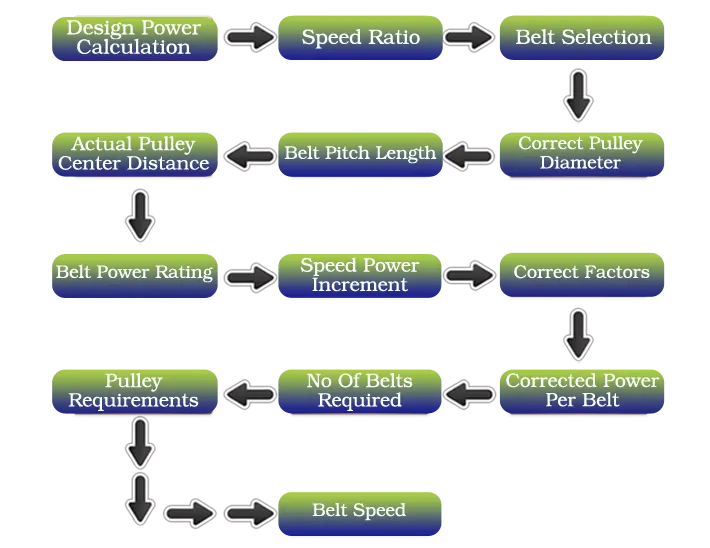
GENERAL V-BELT SELECTION PROCEDURE
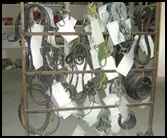
TECHNICAL TIPS ON BELT STORAGE
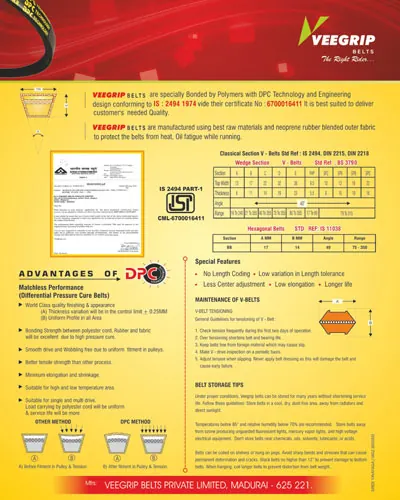
Under proper storage conditions, VEEGRIP belts can be used for many years without deterioration of quality and service life. The following guidelines may be used:
- Store belts in a cool, dry, dust-free area, away from radiators and direct sunlight.
- Temperatures below 850 and relative humidity below 70 percentage are recommended.
- Store belts away from ozone producing unguarded fluorescent lights, mercury vapor lamps, and high voltage electrical equipment.
- Do not store belts near chemicals, oils, solvents, lubricants and acids.
- Belts can be coiled on shelves or hung on pegs.
- However, avoid sharp bends and stresses that can cause deformation, cracks or any other damage to the belts.
- Stack belts no higher than 12" to prevent damage to the belts at the bottom of the pile.
- When hanging, coil longer belts to prevent distortion due to belt weight.
DOWNLOADS

DOWNLOADS